
News · Company update
Zuri's Technology Demonstrator 2.0 engine, built by EdgePerformance
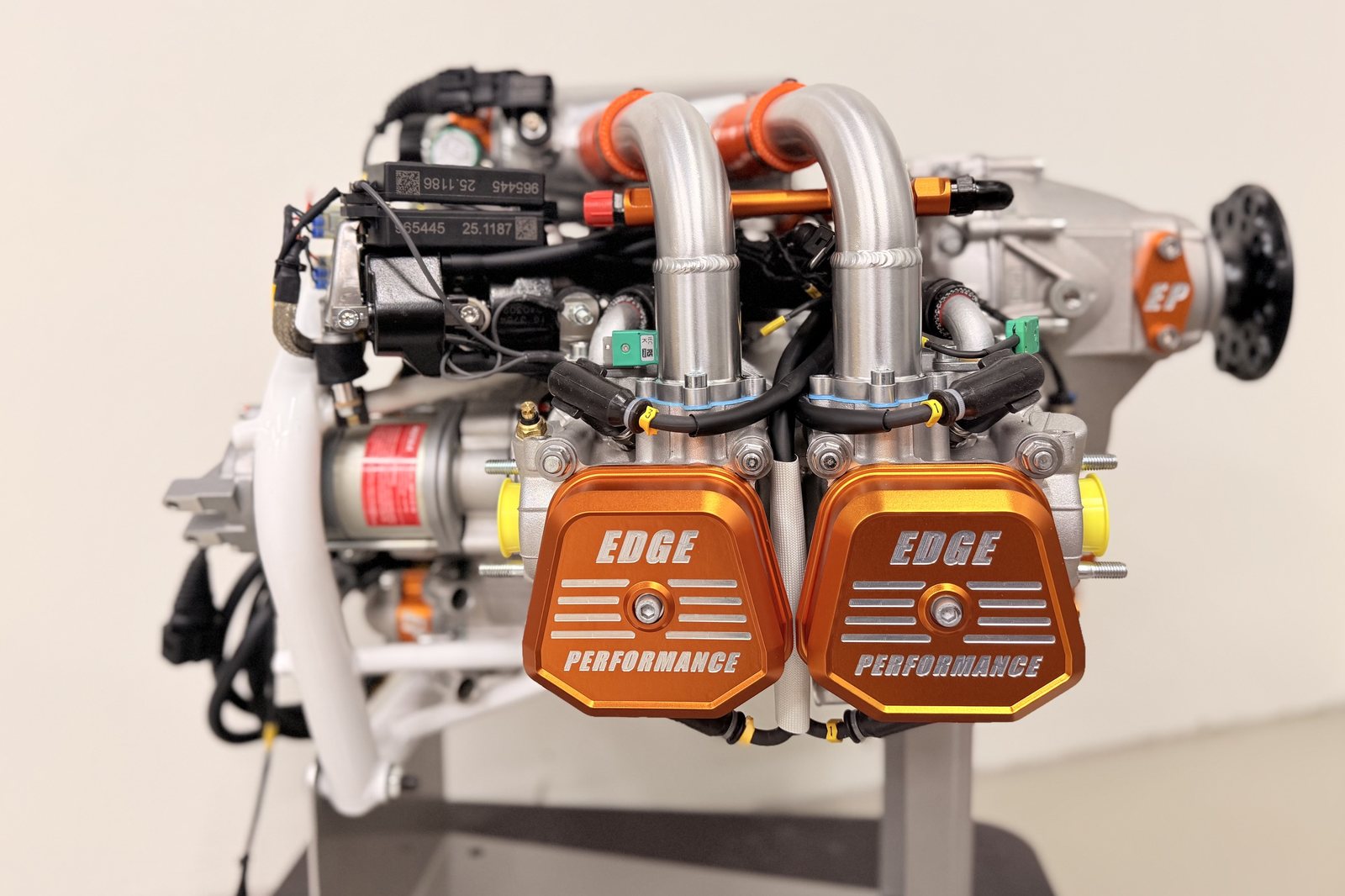
The EdgePerformance engine for Zuri's TD 2.0: EdgePerformance valve covers, fuel injection and the direct-drive PTO flange at right. Photo: EdgePerformance AS
Norwegian engine builder EdgePerformance supplies the flex-fuel Rotax 912 ULS that drives the generator in Zuri's hybrid-electric TD 2.0. Its founder, Thomas Hauklien, on what changes when an aircraft engine never turns a propeller, and Zuri's Radim Laga on what happens after the shaft.
Zuri has named EdgePerformance AS of Notodden, Norway, as the engine partner for its Technology Demonstrator 2.0 (TD 2.0), the hybrid-electric tiltrotor whose architecture underpins Zuri's first product: a long-range uncrewed cargo VTOL, remotely piloted, carrying 115 kg of payload across a 679 km design range, 569 km with a full 30-minute reserve.
The Norwegian company, which builds engines for uncrewed aircraft programs across EU and NATO countries, delivered a heavily modified, fuel-injected Rotax 912 ULS that runs on MOGAS RON 98 (premium automotive gasoline) or on ethanol-blended gasoline with any ethanol content from 1 to 100 percent. AVGAS 100LL works for occasional use; its lead additive leaves deposits in the oil, valves and combustion chamber, and running on it long term would halve the service intervals, as it does on any Rotax burning leaded fuel. In TD 2.0 the engine never turns a propeller. It is the generator engine: it drives a generator that feeds the aircraft's electric motors, at the center of Zuri's hybrid-electric powertrain.
"The hardest part with an engine in a hybrid system is cooling. There is no propeller, like on a conventional aircraft engine, blowing air to keep it cool."
Thomas Hauklien, CEO, EdgePerformance
Zuri recently published a video of the engine starting and running at idle in its Prague hall, the first time it has run in public. After Future Forces Exhibition and Forum in Prague on 21 to 23 October, the engine goes to a dedicated test facility for power and thermal testing under load.
Why put a piston engine in an electric aircraft
Batteries are heavy for the energy they hold, and vertical takeoff spends energy fast. A series hybrid keeps what is good about electric propulsion, a motor on each rotor with fast, precise control and no shafts or gearboxes running through the airframe, and carries its energy as fuel in a tank. The engine turns a generator; the generator feeds the motors. A battery buffers the power peaks of takeoff, transition, and landing, the demanding phases of flight, and recharges from the generator in cruise; if the generator stops, its reserve carries the landing. Range then depends on the tank, not the battery.
EdgePerformance delivers everything from the fuel system to the PTO shaft. Zuri's genset control unit talks to the engine's ECU over CAN, commands the throttle, and commands the motor controller that turns the generator's output into electrical power. Downstream, the aircraft's power architecture feeds the rotors; the battery buffers its peaks in takeoff, transition, and landing, and recharges from it in cruise. Everything after the shaft is Zuri's.
"The hard problems in this aircraft are the electric architecture, the flight control and the airframe. We did not want to add a new engine to that list. EdgePerformance gave us a proven, fuel-flexible power source, so our engineers could spend their time where Zuri adds the most."
Michal Illich, founder and CEO, Zuri
At a glance: the TD 2.0 engine
- Built by
- EdgePerformance AS, Notodden, Norway
- Base engine
- Rotax 912 ULS, factory new, rebuilt with new camshaft, pistons and cylinders, ECU-controlled ignition, EdgePerformance fuel injection and a direct-drive PTO
- Rated power
- 93.0 kW (124.7 hp) at 5,800 rpm; a stock 912 ULS is rated at 73.5 kW (100 hp)
- Weight
- 57 kg dry
- Fuel
- MOGAS RON 98, ethanol blends from 1 to 100 percent; AVGAS 100LL for occasional use
- In TD 2.0
- Drives the generator that feeds the electric motors; started by the generator, no starter motor
Seven questions for Thomas Hauklien
Thomas Hauklien founded EdgePerformance in Notodden, Norway, in 2006. The company has sold about 1,600 engines and 3,500 fuel injection kits for Rotax-powered light aircraft, and its ThrustVik engines, rated at 185 to 210 hp, power uncrewed aircraft up to the 1,350 kg class. Hauklien is CEO and founder, and a test pilot with about 3,500 hours. Answers have been edited for length and clarity.

What is the hardest part of running a piston engine in a hybrid-electric aircraft?
Cooling. On a conventional aircraft engine the propeller blows air over the engine and keeps it cool. In a hybrid system there is no propeller, so that airflow has to come from somewhere else. That is the biggest obstacle with an engine in a hybrid system, and it will be for sure the biggest one here.
The engine drives a generator rather than a propeller. What does that change in how you tune and test it?
Not a great deal beyond the cooling. The load profile of a generator can differ from that of a propeller, but the ECU runs closed-loop control and can correct for that. After the initial load test runs we extract the ECU data and make any fine adjustments to the mapping.
What did EdgePerformance change from the standard Rotax 912 ULS?
We start with a 912 ULS that is new from the factory. We then tear the engine apart and replace the camshaft, pistons and cylinders. We convert the ignition to an ECU-controlled system with variable ignition timing and install our own fuel injection system. For this application the gearbox has been replaced by a direct-drive unit, because the generator needs a higher PTO speed than a propeller.

What fuels can it run on?
The engine is designed to run on MOGAS RON 98 and on ethanol-blended gasoline with any ethanol content from 1 to 100 percent. A flex-fuel sensor measures the resistance of the fuel, which tells the ECU the actual ethanol content, and the ECU changes the amount of fuel injected in real time.
In an uncrewed aircraft there is no pilot to notice a problem. How does that change engine monitoring?
It requires more sensors, more data gathering, and an ECU smart enough to monitor that data in real time and make its own decisions, based on sensor input and on sensor failures.

How was the engine tested before it went to Zuri?
Every engine we build runs for 60 to 90 minutes on our engine dyno. It has to complete a break-in procedure and deliver correct and consistent performance, which is logged in our database and compared to baseline values. Our dyno is a water brake, which we use for endurance testing and repeatable accuracy. It behaves much like a generator, so the test is very representative of generator operation. In this case the first runs changed nothing in the hardware or calibration, because the base engine is an already proven and well-tested platform. What was new for us was running this specific engine on ethanol.

Where does EdgePerformance's work end and Zuri's begin?
The engine supplied to Zuri is based on our proven design; the ethanol option and the direct-drive PTO were unique to this application. We have focused entirely on the propulsion system up to the PTO shaft. Everything after that is Zuri.
Inside the integration: the Zuri side of the shaft
Past the PTO shaft, the work is Zuri's. Radim Laga, Electrical Systems Lead, and his team turn an engine into a hybrid-electric power unit.
Sensors and calibration. "We added more precise sensors on the engine and modified the wiring to the ECU," Laga says. "For example, we replaced the head temperature sensors with more precise ones and did the ECU wiring and calibration for them. There is also a custom fuel level sensor for the tank, which we set and calibrated in the ECU." The ECU itself earns praise: "It lets you customize the sensors, controls, logs and communication. We are happy EdgePerformance chose this particular ECU, because it is very user-friendly."

Started by the generator. In TD 2.0 the engine has no starter motor. The generator spins the engine up, and the starter comes off to save weight. Zuri's own genset control unit, developed in-house, manages the whole power unit: it commands the electronic throttle valve using operating parameters from the ECU, tells the motor controller how much electrical power the aircraft needs from the generator, and handles the electrical protections. "That is a very simple explanation," Laga says, "but the genset control unit is basically the main control unit for the whole genset."
The cooling question. At idle on the Prague rig, the engine confirmed three things: it runs correctly as delivered, the oil and water cooling Zuri designed for it holds, and the sensors feeding its controller read correctly. Full power is the next question, and it is the one Hauklien names first. "We have prepared the engine for power and thermal tests at a dedicated engine facility," Laga says. "The main goal is to find out how much air we will need to keep it in the operational temperature range." The engine will run on E85, 85 percent ethanol and 15 percent gasoline. Zuri expects 20 to 30 percent less heat generation than with standard gasoline, a figure the tests will confirm or correct.
Finding the fuel was its own small project. In Europe, refineries sell E85 in minimum quantities of around 1,600 liters. Zuri found a supplier that sells to racing teams in 55-liter lots.
Once the thermal data is in, Zuri will modify the cooling system and the fuselage to deliver that airflow, and finish integrating the generator with the motor controller and the genset control unit, which is on hold until the thermal results are known.
Built for civil and defense missions
EdgePerformance's engines are classed as dual-use items, so certain exports require a license. Zuri builds on a European, ITAR-free supply base and names its suppliers. This engine configuration contains no ITAR-controlled components.
The same qualities matter to both civil and defense missions. Fuel flexibility means an operator can run on premium automotive gasoline or ethanol blends of any strength, with AVGAS 100LL as an occasional fallback, whether at a regional airfield or a forward logistics site. Continuous sensor monitoring and autonomous fault handling by the ECU are what allow an aircraft with no pilot on board to be trusted with a load. And a proven base engine, tested against baseline on every unit, keeps risk out of the part of the aircraft that is not new.
"It requires more sensors, more data gathering, and an ECU smart enough to monitor that data in real time and make its own decisions."
Thomas Hauklien
TD 2.0's architecture carries directly into Zuri's uncrewed cargo VTOL, which will carry 115 kg across a 679 km design range, 569 km with a full 30-minute reserve, taking off and landing vertically without a runway.
What comes next
The engine's next public outing is Future Forces Exhibition and Forum in Prague, 21 to 23 October. After the show it goes to a dedicated test facility for power and thermal testing under load on E85. TD 2.0's first flight is planned for Q2 2027, when ground test says it is ready.
"The main goal is to find out how much air we will need to keep it in the operational temperature range."
Radim Laga, Electrical Systems Lead, Zuri
About Zuri. Zuri is a Czech aircraft company building a long-range uncrewed cargo VTOL: helicopter access with fixed-wing range, hybrid-electric, remotely piloted. It delivers 100+ kg of cargo, or deploys the sensors and communications a mission needs. It is designed and built in Europe on an ITAR-free supply base, for civil and defense logistics. Founded in 2017 in Prague. zuri.com
About EdgePerformance. EdgePerformance, based in Notodden, Norway, has modified Rotax four-stroke engines since 2006, adding fuel injection, turbocharging and internal upgrades for light aircraft, motorsport and uncrewed aircraft. It has sold about 1,600 engines and 3,500 fuel injection kits, and its ThrustVik engine series, rated at 185 to 210 hp, powers uncrewed aircraft programs across EU and NATO countries.